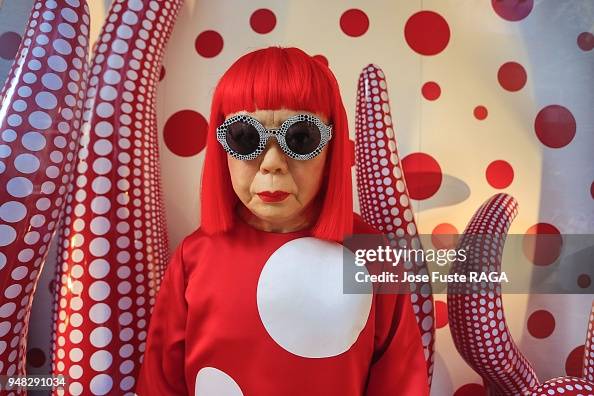
Portrait of artist Yayoi Kusama among her work in Hong Kong, China, on October 4, 2012. (Photo by Jose-Fuste RAGA/Gamma-Rapho via Getty Images)
Japanese artist Yayoi Kusama has died at the age of 97. Her studio confirmed on 27 August 2026 that she had died at a hospital in Tokyo on 14 August. According to her studio, she continued painting until her final days.
Kusama leaves behind a visual language recognised far beyond the art market: dots, pumpkins, Infinity Nets and mirrored rooms. What does her death mean for her market? Do her works automatically become scarcer and more valuable? And what can it teach us about art as an asset? We spoke with Anna from our Art team.
Anna: First, something very simple: no new works can be created. A body of work that was still growing becomes finite. If demand remains strong, that scarcity can support prices.
But I would never turn that into a rule that an artist dies and all their works automatically go up. A study in the Journal of Cultural Economics does find an average posthumous price premium, but the effect varies significantly by artist, age, reputation and the individual work.
Anna: Probably to some extent. But “priced in” is much harder to use in art than in stocks. Art does not have a market price that updates every day. An early painting, a pumpkin, a sculpture and an edition can all have completely different markets.
The market obviously knew that Kusama’s production could not continue indefinitely. At the same time, her oeuvre is now definitively complete and attention has increased. Both can affect the market. How much will only become clear through actual sales.
Anna: Exactly. I would not focus on one headline or one record, but on several results over the coming months. Are works selling above or below estimate? What is the sell-through rate? Are there several serious bidders? Do unique works behave differently from editions?
Only then can we see whether the market itself is changing or whether the main shift is simply increased media attention.
Anna: It shows very clearly that a strong legacy is not built overnight. I look at a few basic things: does the artist have a distinctive visual language? Is the work shown by museums and important institutions? Is there an international collector base? And how scarce and significant is the individual work within the artist’s oeuvre?
Those questions can be applied to artists at very different stages of their careers. With David Hockney, for example, the art-historical relevance is already firmly established. So with our work Lillies, 1971, the focus shifts more toward the specific work itself: the motif, the quality and the special edition of only 35. With Clyde Hopkins, Tree Painting No.2, 1981 is interesting because it comes from his important lyrical period of the early 1980s and, as a unique work, captures that phase very directly.
With Nicolas Party and Salman Toor, what I find especially interesting is their visual language. Untitled (Woman in Green), 2020 shows Party’s intense colour and stylised portraiture very clearly, while Citizens with Flags, 2025 reflects recurring themes in Toor’s work such as identity and belonging. Justin Fitzpatrick also brings figuration and abstraction together in a very distinct way in Chef’s Table, 2020. And in Ermina Avramidou’s Neural Network II, 2025, layered structures move between associations with neural networks and cosmic forms.
Then there are artists where I am watching the institutional development especially closely. Dominique Fung is on view at the USC Pacific Asia Museum in 2026, with another presentation at ICA San Francisco announced; her work Good Fortune Vessel, 2020 returns to Timeless in September. Claire Tabouret was selected for the new contemporary stained-glass windows at Notre-Dame de Paris; her work The Gold Miners, 2017 is a unique work on paper. And Antony Micallef currently has a major solo exhibition at MUCA Munich bringing together more than 50 works; on Timeless, Self Portrait with Chromium Oxide, 2025 is available.
For me, that is a much more useful question than “Who is the next Kusama?”: what signals can we already see today that suggest an artist and a particular work could remain relevant over the long term?
Yayoi Kusama Official Site, Announcement of the Passing of Yayoi Kusama, 27 August 2026; n-tv / dpa, Yayoi Kusama obituary, 27 August 2026; Sahli & Cuntz, Is there a premium for legacy artists?, Journal of Cultural Economics; MASSIMODECARLO and ICA San Francisco on Dominique Fung; Timeless asset pages, checked 27 August 2026.
This article is for informational and educational purposes only and does not constitute investment advice. Collectibles can rise or fall in value and may take time to sell. Past performance and auction results are not an indication or guarantee of future results. Please review the relevant offering documents before making any investment decision.