After years of correction, the whisky market is finally recovering. But not all bottles are behaving the same. Here’s why.

Somewhere in the mountains south of Kyoto, there is a forest that takes two hundred years to produce a single whisky cask. Individual casks cost more than $6,000. The trees are Mizunara — a Japanese oak so dense and so porous that coopers spend decades just learning how to work with it. The flavour that emerges from a well-aged Mizunara cask exists nowhere else in whisky.
And yet, despite the craft it takes to produce a good whisky bottle, the market has gone into a correction in the past years. After a decade of strong appreciation that drew speculative capital into the market, this was inevitable. But the correction worked as a filter, separating the bottles with strong fundamentals from those carried by hype.
Now, the data is beginning to show that for the right bottles, the direction has started to change. The more interesting question is: what is already coming back, and why?
The correction sorted the whisky market into two categories. In one: high-volume releases, anything priced on hype rather than fundamentals. In the other: ghost distilleries, micro-producers, pre-boom Japanese expressions, complete sets of disappearing vintages. The latter were not only more resistant to the correction, they are already leading the recovery.
What do they have in common? Structural scarcity.
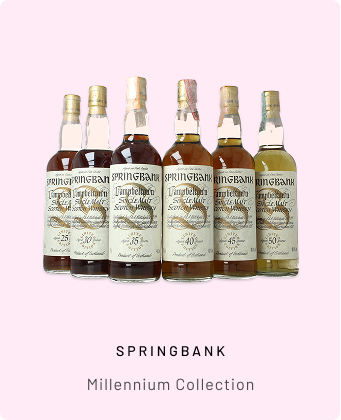
Springbank is the most distinctive case. The distillery has been making whisky the same way since 1828. The barley is still floor-malted by hand. Every stage of production — malting, distilling, bottling — happens within the same walls in Campbeltown. The Mitchell family, who have owned it for five generations, produce roughly 200,000 bottles a year. Macallan, by comparison, produces over twenty million. Every Springbank bottle is scarce before it even leaves the distillery.
The market has noticed. While the broader whisky market corrected, the Springbank Index returned +4.52% over the last 12 months — one of the strongest performances in the category. At Timeless, a Springbank 1993 Mizunara 28 Year Old exited in April at +15.63% in just 12 months.
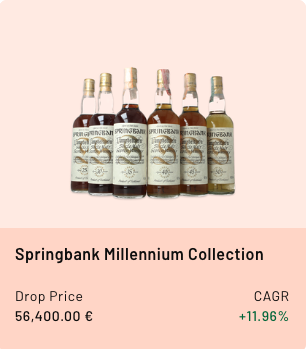
Springbank
Millenium Collection
Japanese whisky tells the same story differently. While Springbank chose not to scale, Yamazaki simply cannot. Japan’s oldest distillery sits on ground that exists nowhere else: the Mizunara forests, a microclimate that cannot be replicated. The trees that produce its casks take two hundred years to mature. There is no shortcut.
Yamazaki has won the ISC Supreme Champion Spirit three years in a row — 2023, 2024, and 2025. No distillery has ever done that. But the highest value is placed in the older bottles. Mizunara expressions from before 2013 — the year the world discovered Japanese whisky — continue to appreciate. Most bottles from that era have already been consumed, which makes the ones that remain all the more rare. Two recent Timeless exits confirmed it: a Yamazaki Hitomi at +11.61% and a Yamazaki 25 Year Old Mizunara at +11.43%, both under six months.
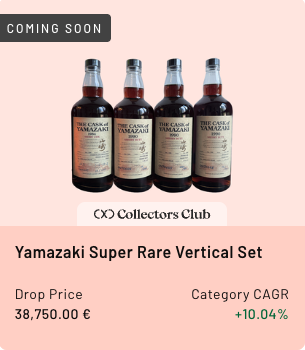
Yamazaki
Super Rare Vertical Set
Then there is Karuizawa, the strongest example of structural scarcity. The distillery closed in 2000. The bottles that existed at that point are all that will ever exist. Every one that gets opened reduces the total. In January of this year, a complete Karuizawa Flower and Bird Series Set sold through Timeless at +30% in six weeks. The same set had already been exited the year prior at +22.68% over thirteen months. Each time, the set was placed and a buyer was waiting.
Behind every one of these exits is the same dynamic: a bottle with irreplaceable provenance, and a buyer who already knew exactly what it was worth.
The most active buyers in this market are not at public auctions. They are private collectors in Japan, Taiwan, and Hong Kong — people who have spent decades building knowledge about specific distilleries, specific vintages, specific cask types. They do not buy on sentiment. They buy on understanding, which is why their demand does not soften when the broader market does.
Christian Leusder of the East Asia Whisky Company, our partner who placed three of our four recent exits through his private collector network across the region, describes it simply:
The hold periods we are seeing on Yamazaki — under six months in several cases — are possible because the sourcing matches the demand. Private collectors in Japan and Taiwan are not waiting. When the right bottle appears, the question is placement, not price discovery.
Christian Leusder, East Asia Whisky Company
The future of whisky belongs to the bottles where scarcity is not a policy. It is a consequence: of trees that take two hundred years, of distilleries that closed or refuse to scale, of vintages that existed long ago.
The Mizunara saplings in the mountains south of Kyoto will be ready for cooperage in approximately the year 2225. The bottles that carry the spirit of the forests that exist today are aging now, in warehouses that will not produce them again. The people who understand this are not waiting for the correction to end. They are buying more.
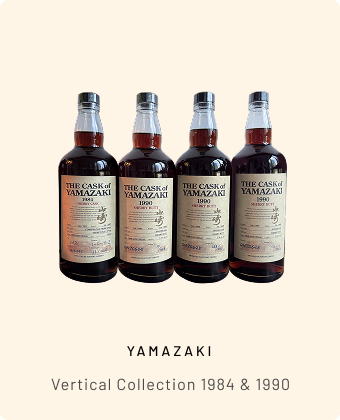
Yamazaki Vertical Collection 1984 & 1990
Springbank Millenium Collection
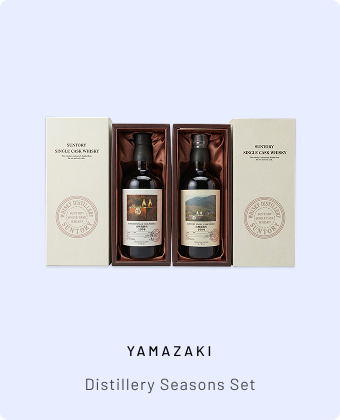
Yamazaki Seasons Set