
On a Rolex or Tudor, the dial is often what sets a watch apart. Many of the nicknames collectors use, Panna and Beach among them, describe the dial. The five watches in our Rare Dials selection show five ways a dial ends up different. Three were different from the start: one made for the Saudi Border Forces, one with a turquoise dial, and one with a calendar and chronograph sharing the same face. The other two changed after they left the factory: one was reworked by an independent customiser, and the other changed with age.
Among the best-known commissioned Rolex dials are those bearing Oman’s Khanjar emblem, a traditional dagger over crossed swords. Sultan Qaboos bin Said ordered Rolex watches to present as gifts to dignitaries and members of his staff. Some of these commissions passed through the London jeweller Asprey, whose name can also appear on the caseback.
Saudi organisations also had their emblems placed on Rolex dials, including the Armed Forces and Border Forces. The crests identify the organisation associated with each particular version.
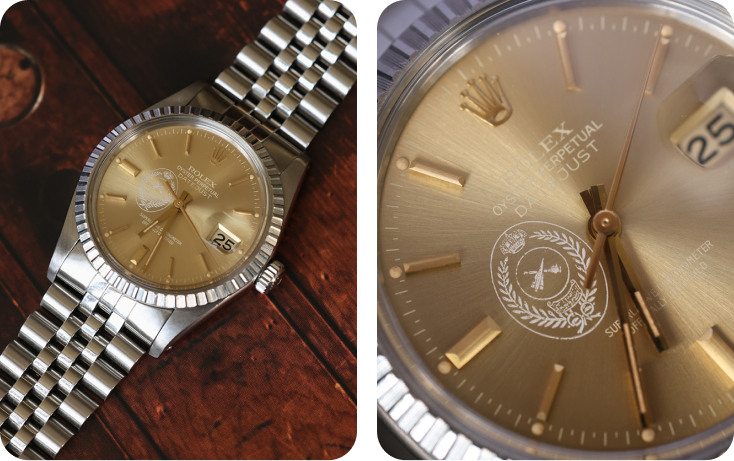
The Datejust 16030 “Saudi Border Forces” in the Timeless collection dates to 1982. Its champagne-coloured dial bears the Saudi Border Forces crest, with a corresponding emblem engraved on the caseback. The 36 mm steel case and Jubilee bracelet give it the familiar appearance of a vintage Datejust, while the matching insignia identify the particular version collectors are looking at. Dials like this were made to a client’s order, not for general sale.
1982 · 36 mm · Steel
During the 1970s, Rolex began fitting the Datejust and Day-Date with dials cut from natural stone. Lapis lazuli, malachite, tiger’s eye, onyx and turquoise brought colours and textures that varied from one piece of material to another. Specialist dial maker Stern Frères entered stone-dial production around 1970, with Rolex becoming an important client.
Making these dials required exceptional care. Watch historian Dr Helmut Crott documents a lapis lazuli Datejust dial made by Stern in 1977 whose stone layer was just 0.4 mm thick. A thin metal backing supported the stone, which needed openings for the hands, calendar and, on some versions, applied markers. Ultrasonic machining was among the techniques used to form these openings. The material could chip or fracture during manufacture, and hairline cracks remain an important condition issue on vintage examples.
The finished designs varied considerably. Some onyx dials omitted hour markers, leaving an uninterrupted black surface, while tiger’s eye offered a silky, shifting lustre. Stone also appeared in steel watches, including a circa-1974 Datejust Ref. 1601 with lapis lazuli documented by Phillips. It later reached sports models such as the onyx-dial Submariner Ref. 16618. A 1998 white-gold Daytona Ref. 16519 with blue sodalite, diamond markers and the Zenith-derived calibre 4030 shows that stone-dial Daytonas preceded the Beach series.

The Ref. 116519 “Beach” models belonged to the first generation of Daytonas powered by Rolex’s own chronograph movement, the calibre 4130, introduced in 2000. They combined white-gold cases with brightly coloured dials and matching straps. Blue used turquoise, green used chrysoprase, and the pink and yellow versions used mother-of-pearl. Rolex made them for only a few years and has never said how many.
The Daytona Ref. 116519 Beach Blue Turquoise at Timeless pairs its turquoise dial with a 40 mm white-gold case and matching blue strap.
Calibre 4130 · 40 mm · White gold
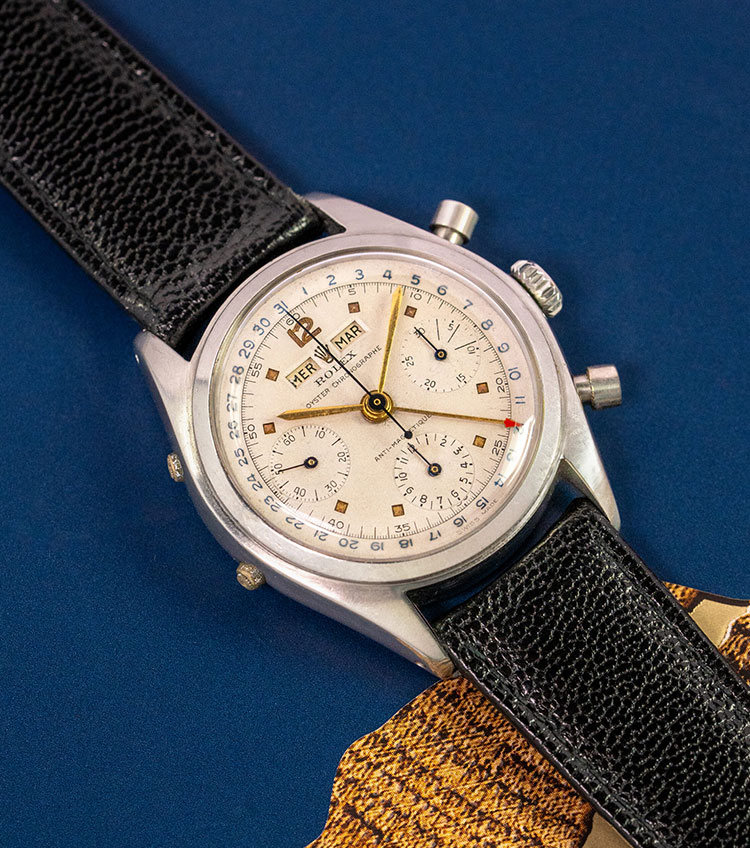
Introduced around 1950, the Ref. 6036 combined a chronograph with a triple calendar displaying the day, date and month. Two windows show the day and month, a separate hand points to the date around the edge, and three subsidiary dials sit within the same face. Its manually wound Valjoux-based calibre 72C made room for substantially more information than the later Daytona would display.
The Timeless example dates to 1953, with a 36 mm steel case and its original white dial, which has developed a beautiful patina. Original dials like this are very hard to come by on the market. The model family takes its familiar “Jean-Claude Killy” nickname from the Olympic ski champion and Rolex ambassador.
Christie’s cites scholars’ estimates of around 500 made in steel, and only around 75 examples can be traced on the market today. As collectors, museums and funds acquire them, fewer remain available. Phillips lists the reference among Rolex’s key collectible models.
1953 · 36 mm · Steel

Tudor introduced its first automatic chronographs in 1976, twelve years before the automatic Daytona. The Valjoux 7750 required a thicker case to accommodate its winding rotor, giving rise to the “Big Block” nickname. Its architecture also changed the dial, placing the registers towards the left and the date at 3 o’clock.
The 1984 Ref. 9420 at Timeless adds independent customisation by Project X. Its grey dial, contrasting black registers and PVD-coated case give the vintage chronograph a darker, more contemporary appearance. The particular character of this watch comes from that independent reinterpretation of an established Tudor design.
1984 · 40 mm · PVD steel

Some of Rolex’s most discussed dial variations developed through ageing. Rolex launched the Explorer II Ref. 16550 in 1985 and made it for less than five years. A flaw in the paint used on its white dials turned many of them a warm cream colour over time, earning the nickname “Panna”, Italian for cream.
The example at Timeless dates to 1986, with a 40 mm steel case, fixed 24-hour bezel and additional 24-hour hand. Phillips describes the white-dial 16550 as a favourite with collectors of Rolex sports watches.
1986 · 40 mm · Steel
This article is for informational and educational purposes only and does not constitute investment advice. Collectibles can rise or fall in value and may take time to sell. Capital is at risk, including possible total loss. Past performance is not an indication or guarantee of future returns. Review the asset information, fees and contractual documents before investing.