The global gemstone market is projected to grow from $38.4 billion in 2026 to $72.8 billion by 2036. Knight Frank’s Wealth Report shows that 23% of ultra-high-net-worth individuals now consider gemstones as alternative investments, up from 18% just two years ago. A market that has always moved quietly is starting to boom.
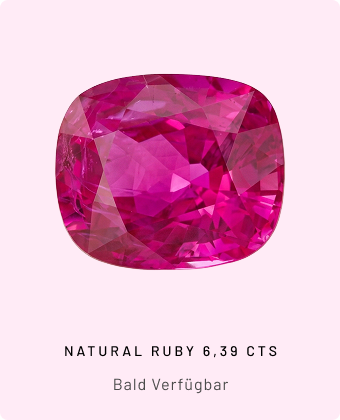
But access has always been the problem. Selecting the right stone requires not only deep expertise, but a network that takes generations to build. That changes with our new partner: Carat Investments. Founded by Fabian Lauterwasser on the foundation of the Schupp family office from Pforzheim — a name in the gemstone world since 1744 — they bring nearly 300 years of sourcing experience and international relationships to the Timeless platform. We sat down with Fabian to give you an insider’s view of how this market really works and introduce our first drop together: a 6.39-carat Burmese ruby that goes live on Tuesday.
Fabian: It’s less about a lack of attractiveness and more about a lack of access. Institutional and modern investors typically prefer markets that are standardized, transparent, and liquid. The gemstone market has historically been fragmented, opaque and highly relationship-driven. If you didn’t have the right network, you simply had no access.
Meanwhile, the market’s advantages were long underestimated: strong value preservation during crisis periods, low correlation to traditional asset classes, globally demand with cultural depth — and a primary market that’s steadily shrinking due to depleted mines. Gemstones were never “undiscovered,” they were hard to access and demanding in their complexity. We perceive this as a European effect. In other parts of the world, the understanding of gemstones as a store of value is far more deeply rooted.
That’s changing now. The infrastructure is becoming more structured. Access is improving. And for the first time, the highest-quality segment is becoming investable at a scale that makes it relevant to a modern portfolio.
There isn’t a single characteristic that determines value, but rather a rare combination of many characteristics within one stone.
The industry talks about the “4 Cs” — carat, color, clarity, and cut — and that’s a useful starting point. But what truly matters, especially in an investment context, is how multiple quality and rarity factors converge in a single object. Gemstones are multifactorial assets, where geology, rarity, and aesthetics interact in a very specific way.
The more of these factors come together in one stone, the more its market value increases, particularly at the high end, where exceptional gemstones become genuinely irreplaceable.
Talking about gemstone performance as a whole is not just difficult, it’s misleading. Performance here isn’t a property of the asset class. It’s a result of selection.
The diamond market illustrates this well. In 2025, smaller stones lost significant value while larger, exceptional-quality diamonds gained – in the same market environment. Same asset class, completely different outcomes, determined entirely by which stones you held.
For investors, the implication is clear: there is no single gemstone market. There are multiple segments, and they can move in very different directions. What matters is having access to the right stones and the expertise to identify them. That’s precisely why we value the collaboration with Timeless: it allows us to be selective and focus exclusively on exceptional quality.
In the long-term, the outlook remains strong. The market is supported by growing global wealth, culturally embedded demand, and a finite supply base. According to industry reports from LBBW and Allianz, investment-grade gemstones have delivered returns in the range of 11–18% annually over the past decade.
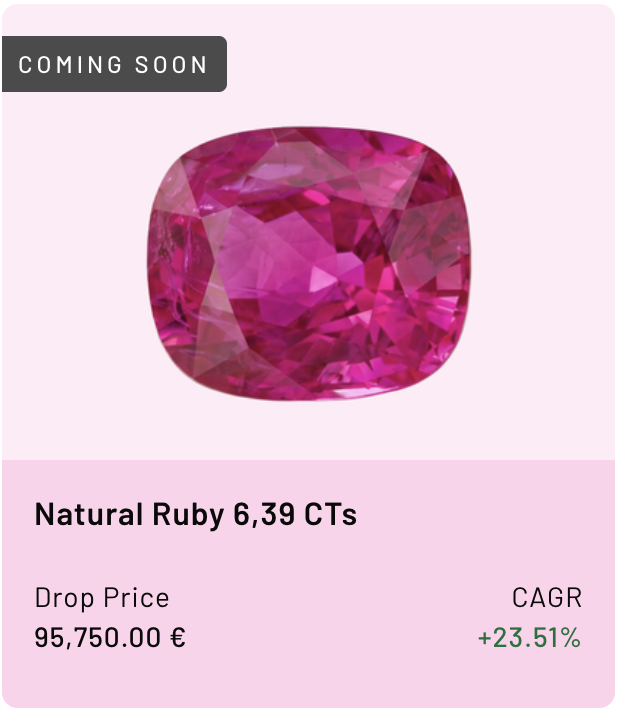
What makes this stone exceptional is not one single factor, but the combination of several rare characteristics coming together at once.
It starts with the origin. Rubies from Myanmar—historically known as Burma—are widely considered the most prestigious in the world, and that provenance alone already places a stone in a different category.
Then there’s size. Once you move beyond five carats, high-quality rubies become exponentially rarer. At 6.39 carats, you’re already in a segment where true investment-grade stones are extremely limited. Add to that the color saturation, the transparency, the cut — each factor narrows the field further.
What ultimately sets this ruby apart is that all of these elements align in one stone. At this level, rarity is absolute. And stones like this rarely come to market.
Ruby
Burma
Yes — and the common factor between them is scarcity. Gemstones are formed by nature, which means supply is finite by definition. But in several key segments of the market, it’s not just finite, it’s disappearing.
The most well-known example is the Argyle mine in Australia, once the world’s primary source for colored diamonds. It closed permanently in 2020. That supply is gone. We’re seeing similar dynamics in major ruby-producing regions, where output has declined to historically low levels. High-quality emeralds face the same pressure.
Today’s market is dominated by treated gemstones, stones where color and clarity have been artificially enhanced. Untreated stones, where what you see is what geology produced, are significantly rarer. That’s where serious investment is concentrating.
The gemstones market is often misunderstood as niche or collector-driven. In reality, it is increasingly institutional, just not in the way investors are used to.
What makes this market interesting is that demand isn’t purely return-driven, which tends to result in a more stable demand structure than in many traditional asset classes.
Today, the core buyers include ultra-high-net-worth individuals, particularly from Asia and the Middle East, as well as family offices that use gemstones as part of broader diversification strategies. Alongside them, there’s a growing presence of investment-focused collectors, as well as wealth managers, insurers, and pension funds allocating selectively to real assets.
Demand is ultimately driven by a mix of factors: diversification into tangible assets, culturally rooted appreciation, and the unique combination of wealth preservation and prestige that gemstones offer. In periods of uncertainty, declining trust in currencies and geopolitical tensions can further reinforce this demand.
The Burmese ruby 6,39 CTs drops this Tuesday at 6PM. Mark as favorite now for a chance at Early Access.
Burma Ruby6,39 cts
Ceylon Sapphire 30,35 cts